.png)

Utilizing a Pre-Anoxic Denitrification Zone or Sidestream Deammonification
Many food and beverage processors focus their wastewater strategies on biochemical oxygen demand (BOD) and total suspended solids (TSS). Those parameters are important, but nitrogen can become an equally significant driver of treatment capacity, energy demand, operating cost, and compliance risk.
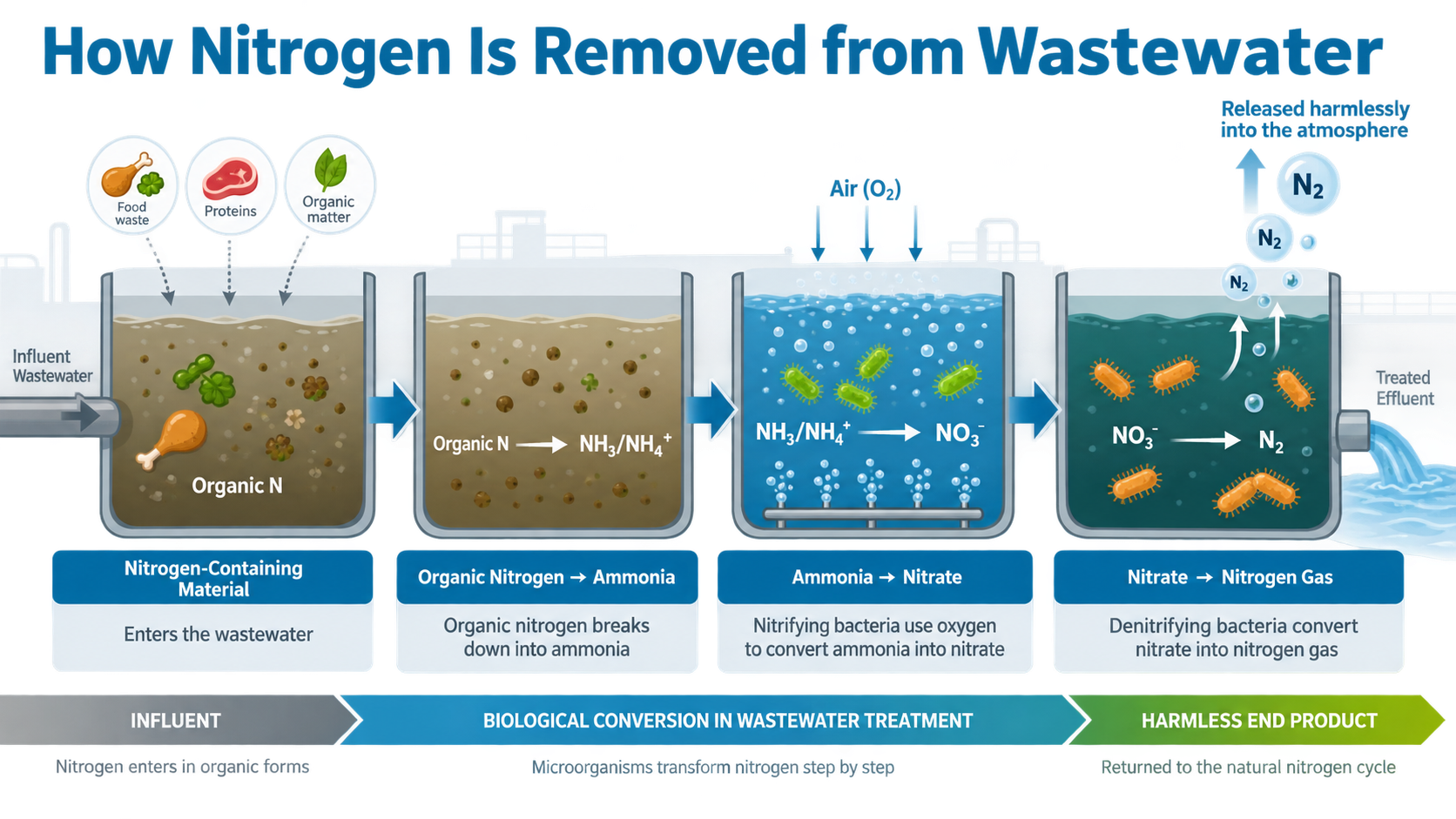
Depending on the products being made, wastewater from the production facility may also contain a significant concentration of nitrogen from proteins, ingredients, product losses, cleaning processes, and other materials that enter the wastewater stream.
As those nitrogen-containing organic materials break down, organic nitrogen is converted into ammonia (NH3) or ammonium (NH4+) (depending on the pH and the temperature of the wastewater). Both are forms of nitrogen and are commonly grouped together as “ammonia nitrogen” in wastewater treatment discussions.
Ammonia must be carefully managed because it can be harmful to aquatic life, consumes oxygen in receiving waters, and can contribute to broader nutrient-related water quality concerns.
This becomes especially important as production increases for food and beverage manufacturers. Increased production may mean more wastewater, more cleaning, or more nitrogen-containing material entering the waste stream. Even if the concentration of ammonia remains relatively stable, a higher wastewater flow can increase the total pounds of ammonia reaching the treatment system each day. Changes in products, ingredients, production practices, or product losses can increase that load further.
Additionally, more stringent discharge limits can create a different challenge. New discharge limits may require the facility to remove a greater percentage of ammonia before discharging the treated wastewater. A system that performed adequately under previous limits may require more treatment to meet a lower ammonia or total nitrogen limit.
In a conventional biological treatment system, specialized microorganisms known as nitrifying bacteria begin this process by converting ammonia into nitrite (NO2-) and then nitrate (NO3-). This process, known as nitrification, requires oxygen and is performed by bacteria that grow relatively slowly. Denitrification is the second phase of the process that uses heterotrophic bacteria to convert nitrate into harmless nitrogen gas to the atmosphere (Earth's atmosphere is 78% nitrogen).
As the ammonia load increases, the treatment system may need:
• More oxygen to support nitrification
• More alkalinity to maintain stable pH conditions
• Sufficient solids retention time (SRT) and nitrifying biomass to maintain nitrification,
• More reliable control of SRT, temperature, pH, and dissolved oxygen
The right approach for effective nitrogen removal depends on where the nitrogen originates, how concentrated it is, whether sufficient carbon and oxygen are available, what the discharge requirements are, and how the existing treatment system is configured.
Nitrogen Management Strategies
Two technologies that may enter this conversation at this point are an anoxic selector and sidestream deammonification.
Although both can contribute to a broader nitrogen-management strategy, they address different treatment needs and are not direct substitutes.
What is a Pre-Anoxic Dentrification Zone (like an Anoxic Selector)?
A selector is a relatively small, intensely mixed zone or tank positioned near the beginning of an activated sludge treatment process. Incoming wastewater and return activated sludge (RAS) are brought together under controlled aerobic, anoxic, or anaerobic conditions.
Anoxic (meaning "without oxygen") is an environment that lacks dissolved oxygen but still contains chemical-bound oxygen (such as nitrite, nitrate, or phosphate) typically corresponding to an Oxidation Reduction Potential (ORP) values between -100mV and +100mV.
The purpose is to create an environment that favors microorganisms with desirable growth and settling characteristics. Properly designed selectors can help suppress filamentous organisms and encourage the formation of stronger, better-settling biological floc. Research defines selectors as zones upstream of the main aeration basin that create a concentrated substrate environment and notes that aerobic, anoxic, and anaerobic selector configurations have been used to control filamentous bulking.
In an anoxic selector, nitrate can serve as the electron acceptor while readily biodegradable carbon in the incoming wastewater supplies the energy needed for denitrification. The process therefore can accomplish several objectives:
• Reduce nitrate as part of the facility’s overall nitrogen-removal process
• Use influent carbon for denitrification before that carbon is consumed aerobically
• Reduce a portion of the downstream aeration demand
• Improve the capacity and stability of an existing activated sludge system
• Improve sludge settleability and help control filamentous growth
An important technical distinction is that an anoxic selector does not independently remove incoming ammonia. Ammonia must first be converted to nitrate or nitrite through nitrification in an aerobic portion of the treatment process. An internal mixed-liquor recycle (IMLR) stream can then return that oxidized nitrogen to the anoxic zone, where denitrifying organisms convert it to nitrogen gas.
The selector is therefore part of an integrated mainstream biological treatment strategy rather than a stand-alone ammonia-removal reactor.
When Does a Selector Make Sense?
An anoxic selector may be attractive when a facility:
• Wants to integrate nitrogen removal into an existing activated sludge process
• Has sufficient readily biodegradable carbon in its wastewater to support denitrification
• Has available nitrification capacity or can add that capacity in the aerobic system
• Needs a relatively straightforward and operationally familiar treatment configuration
• Needs to improve sludge settling or address filamentous bulking
For food and beverage facilities, the availability of biodegradable organic carbon can make a selector especially valuable. Instead of treating BOD only as a load to be removed through aeration, the system can use a controlled portion of that carbon to support denitrification, and simultaneously reduce BOD load to the aeration system.
However, selector performance depends heavily on wastewater characteristics, solids retention time, selector loading, mixing, recycle configuration, and operating conditions.
What Is Sidestream Deammonification?
Sidestream deammonification is designed for a very different application: treating a separate, concentrated, ammonia-rich liquid stream before it returns to the main treatment process.
These sidestreams are commonly associated with solids processing, particularly reject water or centrate generated during the dewatering of anaerobically digested biosolids. The Water Research Foundation identifies high ammonia concentration, elevated temperature, and limited alkalinity as characteristics that can make dewatering reject water both challenging and suitable for specialized sidestream treatment.
Deammonification typically combines two biological steps:
• Ammonia-oxidizing bacteria convert a portion of the ammonia to nitrite.
• Anaerobic ammonium-oxidizing bacteria, commonly called anammox bacteria, use the remaining ammonia and the produced nitrite to form nitrogen gas.
Unlike conventional denitrification, the anammox portion of the process does not require an organic carbon source.
Because only part of the ammonia is oxidized aerobically and supplemental carbon may not be required, deammonification can lower oxygen and external-carbon requirements compared with conventional nitrification-denitrification. It has proved effective for nitrogen removal from dewatering reject water and can be particularly attractive when mainstream nitrogen removal would otherwise require added carbon or alkalinity.
When Does Sidestream Deammonification Make Sense?
Sidestream deammonification may warrant consideration when a facility:
• Produces a distinct, concentrated, ammonia-rich sidestream typically through anaerobic digestion and biosolids dewatering processes that recycle ammonia to the main plant
• Wants to reduce that load before it reaches the main biological process
• Faces limitations in mainstream aeration or nitrification capacity
• Has the operational resources and process controls required to maintain specialized biological populations
For facilities with an identifiable concentrated side steam, there may be many economic and biological advantages for separate deammonification. However, many food and beverage plants do not produce a sidestream with the flow, temperature, alkalinity, or ammonia characteristics.
Selector Versus Sidestream Deammonification
The most useful comparison is not “Which technology is better?” It is “Where is the nitrogen, and what problem are we trying to solve?”
An anoxic selector is generally part of the mainstream process - It receives plant wastewater and return biomass, uses available organic carbon, supports denitrification, and can improve sludge settleability and overall biological-process performance.
Sidestream deammonification treats a concentrated recycle stream, targeting a relatively small flow carrying a disproportionately high ammonia load and removes much of that load before the sidestream returns to the main treatment system.
A selector supports a broader treatment process
It still depends on an aerobic nitrification step to convert ammonia into nitrate or nitrite before denitrification can occur.
Deammonification directly converts ammonia and nitrite to nitrogen gas. It requires careful process control to retain slow-growing anammox organisms and limit competition from nitrite-oxidizing bacteria.
What Other Nitrogen-Management Options Are Available?
Selectors and deammonification are only two tools within a broader nitrogen-management strategy options.
Depending on the wastewater, existing infrastructure, discharge requirements, and available footprint, other approaches may include:
• Simultaneous nitrification-denitrification: Carefully controlled oxygen conditions allow nitrification and denitrification to occur within the same basin or biological floc.
• Pre-anoxic or post-anoxic treatment: Anoxic zones can be positioned before or after aerobic treatment depending on carbon availability and the required effluent quality.
• MBBR or IFAS systems: MBBR or IFAS increase nitrifying biomass inventory and ammonia-removal capacity without requiring a proportional increase in suspended-growth basin volume. Internally, Probst has evaluated an MBBR/IFAS alternative incorporating an anoxic selector to improve capacity, nutrient removal, and settleability.
• Conventional sidestream nitrification or nitrogen removal: A concentrated recycle stream can be treated using conventional biology instead of anammox when the facility’s conditions or operational needs favor that approach.
• Bioaugmentation or sidestream nitrifier cultivation: A sidestream process can grow nitrifying organisms that are returned to the mainstream system, strengthening mainstream nitrification. The Water Research Foundation identifies pre-nitrification and bioaugmentation regeneration as options for managing reject-water nitrogen.
• Post-aerobic digestion: Residual ammonia can be nitrified after anaerobic digestion, with nitrogen removal potentially achieved through controlled simultaneous nitrification-denitrification or related pathways.
The Right Technology Starts with the Right Question
Advanced wastewater treatment is not about selecting the most complex technology. It is about understanding the complete treatment system and applying the right process in the right location.
For one facility, an anoxic selector may provide a practical way to improve settling, use influent carbon more efficiently, support nitrogen removal, and increase biological-process stability.
For another, a concentrated ammonia-rich recycle stream may justify sidestream deammonification.
For many food and beverage processors, the right solution may be an integrated combination of process optimization, selectors, additional nitrification capacity, biofilm technology, sidestream management, or operational modifications.
The Probst Group’s wastewater engineers, scientists, and operators evaluate the complete process, from production and wastewater generation through final treatment. By identifying where nitrogen enters the system and how it moves through the treatment process, we can help determine which strategy provides the right balance of performance, capacity, operating cost, reliability, and long-term flexibility.
