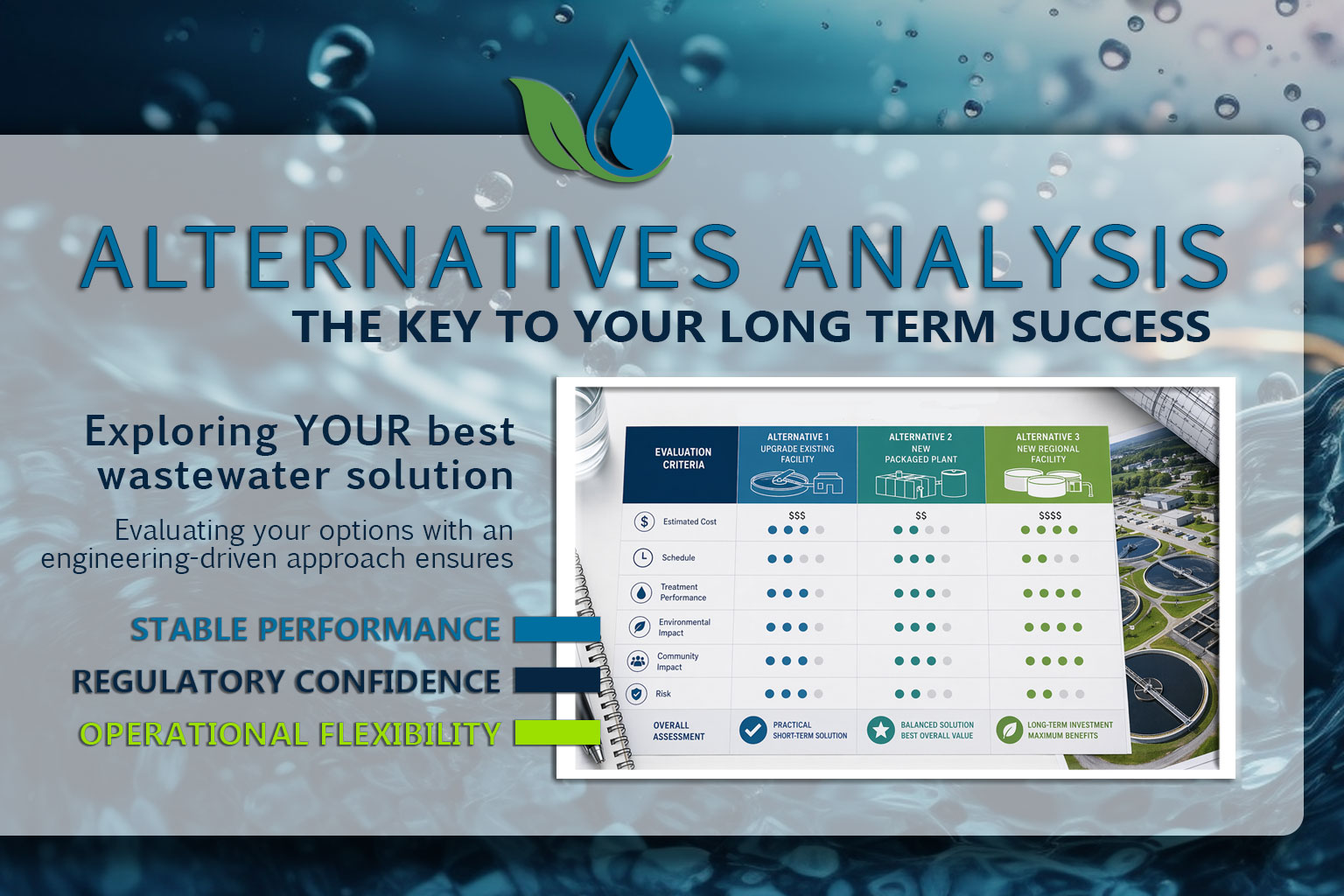

The Importance of evaluating your options with an engineering-driven approach
Beyond the Basis of Design: Why Alternatives Analysis isthe Key to Long-Term Success
In a recent post, we emphasized the importance of targeted sampling and fully understanding your waste stream as the foundation of any successful wastewater project. (Missed that post? You can catch up here.)
That work is what allows a facility to move beyond reactive “fire-fighting” and toward a proactive, engineered strategy that truly delivers long-term results and flexibility. Through targeted sampling, you begin to establish a defensible basis of design - one grounded in real operating data, not assumptions.
At this stage, you’ve identified your key waste streams, quantified variability, and defined the parameters driving operational risk - whether that’s BOD spikes, FOG (Fat, Oil, and Grese) loading, flow variability, or nutrient imbalances.
But once you reach that level of clarity, the question becomes: what do you do with it?
For many facilities, this is where the process starts to accelerate - sometimes in the wrong direction.
There’s often pressure to move quickly into a solution. Apiece of equipment is suggested. A vendor proposes a system. Internally, there’s a push to “just fix it” and restore stability. And while those instincts are understandable - especially when compliance or production is at stake - they can lead to premature decisions and costly headaches.
The reality is, there is rarely just one viable solution.
In fact, there are often multiple approaches that can address the immediate issue. A system may bring a lagoon back into compliance. A pretreatment upgrade may reduce surcharges. A single unit operation might smooth out a specific bottleneck. On paper, many of these options can “solve” the problem in front of you.
But wastewater treatment systems don’t operate on static conditions. They operate in environments defined by variability - seasonal production swings, changes in product mix, cleaning cycles, expansion plans, and evolving discharge limits. A solution that performs well under current conditions can quickly become a constraint if it wasn’t selected with that variability in mind.
That’s where many systems begin to fall short - not because they were poorly designed, but because they were selected too narrowly. Wastewater treatment is not a one-size-fits-all application. And more importantly, it’s not a single-point-in-time decision.
The most successful wastewater treatment projects - the ones that deliver stable performance, regulatory confidence, and operational flexibility over the long term - are built on a much more disciplined approach. They start with a comprehensive Alternatives Analysis.
A true Alternatives Analysis goes beyond comparing equipment or price points. It is a structured, engineering-driven evaluation of multiple treatment pathways, each assessed against a consistent set of criteria:
Rather than asking, “What will fix today’s issue?” the question shifts to:
“What solution is best aligned with where this facility is going - and how it operates in the real world?”
That shift is what separates short-term fixes from long-term infrastructure decisions.
Because at the end of the day, the goal isn’t just compliance. It’s building a system that performs reliably under changing conditions, supports production growth, and reduces operational risk over time.
And that starts by taking the time to explore the full landscape of viable solutions - before committing to just one.
Understanding the Role of Alternatives Analysis
An effective alternatives analysis is not a side-by-side comparison of equipment - it’s a decision framework that connects your wastewater strategy directly to your facility’s long-term business objectives.
At its core, the process starts with defining what success actually looks like for your site. That’s rarely a single metric. It’s a balance of compliance, reliability, operating cost, labor usage, and future growth combined with other factors or initiatives that may be unique to your facility.
The analysis forces a critical alignment:
What are you trying to achieve - and what are the real-world constraints of your operation?
From there, the approach broadens. Rather than evaluating a single path, the alternatives analysis explores a full range of viable treatment strategies, each assessed against consistent technical, operationa criteria, and overall costs – including both capital and operational. The goalis not just to identify a solution that works today - but to determine whichapproach will continue to perform as your facility evolves.
How a Comprehensive Analysis Takes Shape
To get there, the evaluation has to move beyond surface-level comparisons and into a deeper, more structured assessment.
Key areas of focus typically include:
The Risk of Vendor-Led Decisions
In the food and beverage industry - particularly in dairy - there is no standardized wastewater profile. No two facilities operate the same way, and no two waste streams behave identically.
That reality makes “pre-packaged” solutions inherently limited.
Technology providers are often highly knowledgeable within their specific offering - but their recommendations are naturally framed within the scope of what they sell. That’s not inherently wrong, but it is inherently narrow.
The risk is that the solution becomes defined before the problem is fully understood.
An independent, engineering-led approach shifts that dynamic. Instead of starting with a product, the process starts with you, your facility, your data, your variability, your constraints, and your goals.
From there, technologies are evaluated as tools - not starting points.
That distinction matters, because it’s often the difference between a system that checks a box - and one that continues to perform as conditions change.
Moving From Strategy to Execution
When a facility invests the time to complete a rigorous Alternatives Analysis, it fundamentally changes how decisions are made - and how projects perform.
At the end of the day, wastewater treatment isn’t just about maintaining compliance.
It’s about ensuring that your infrastructure supports production - consistently, predictably, cost-effectively, and without becoming a constraint on growth.
Facilities that approach wastewater this way don’t just solve problems - they build systems that absorb variability, adapt to change ,and operate as long-term assets.
And that begins by translating your basis of design into a clear, evaluated path forward - before a single piece of equipment is selected.
